
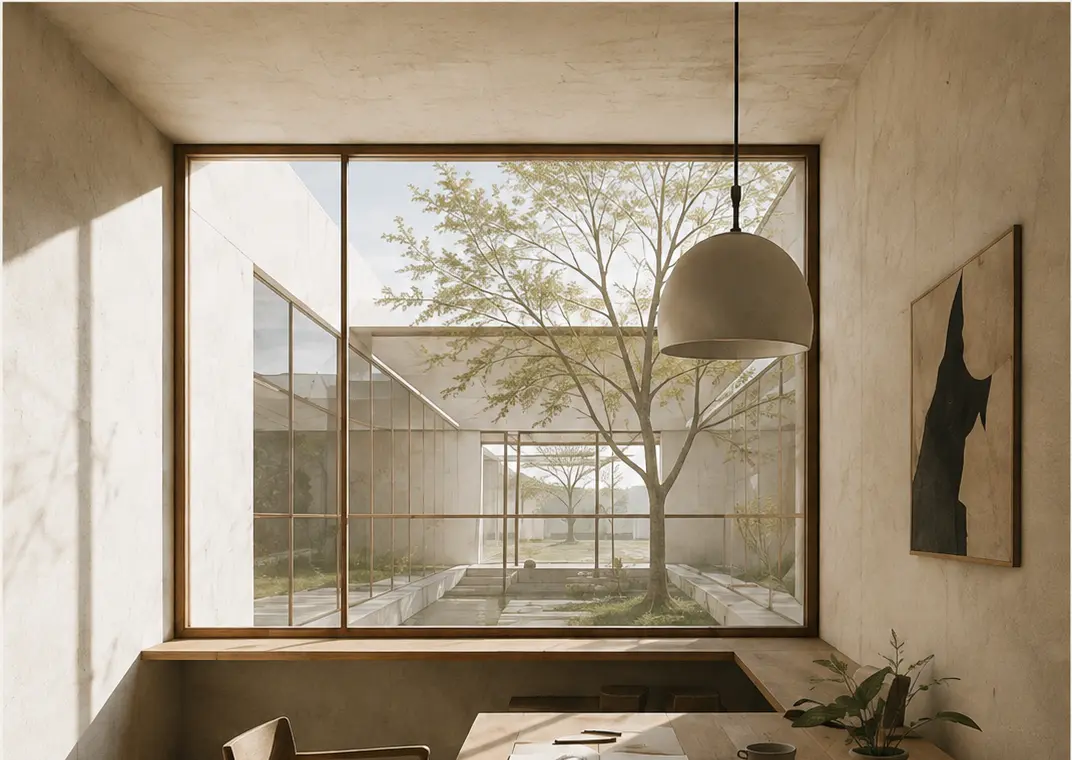
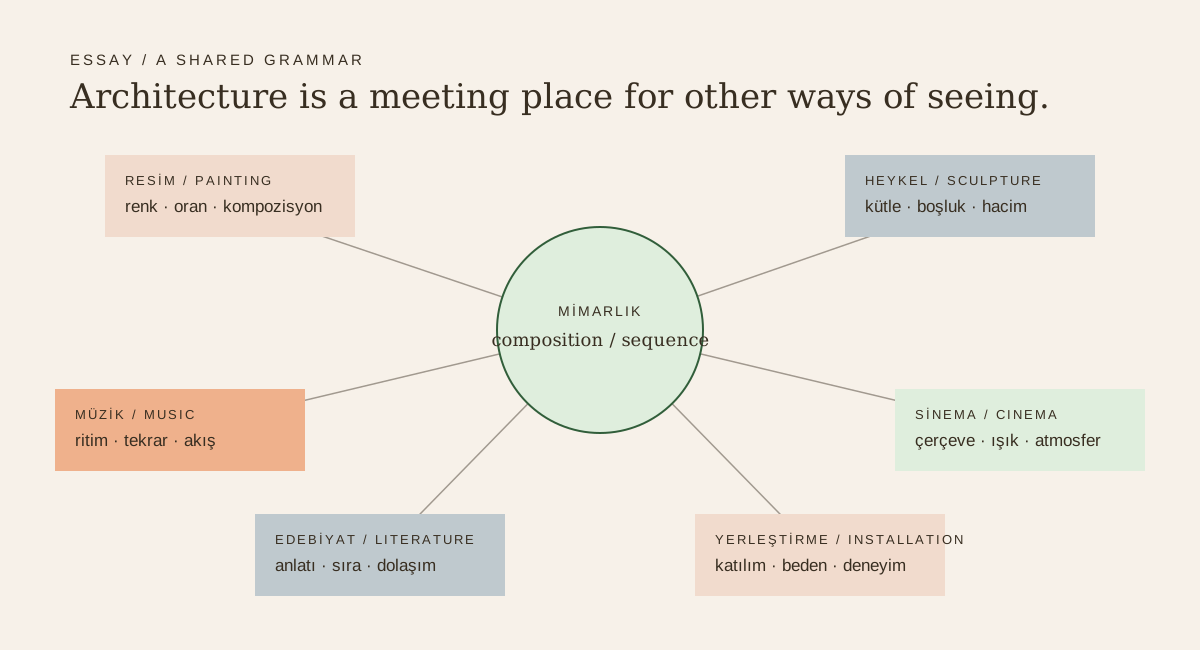
To relate architecture to other arts is not to attach an art-history label to every building. The simpler—and harder—question is this: which ways of thinking from other arts accompany us when we make a space? Composing with colour, feeling void as a mass, ordering repetition as rhythm, or drawing a body into a narrative are shared words that travel between disciplines.
Painting: composition and colour
When we try to turn a painting into an architectural plan, the result is often weak. A painting’s force is not in a direct transfer of form, but in the way it organises looking. Colour, proportion, void and emphasis teach us how to sequence a wall, an opening or a field of light.
To learn from painting is therefore not to paint a facade like a canvas. It is to design when a space is seen as a whole and when it breaks into fragments. Composition becomes a choreography of looking rather than a fixed image.
Sculpture: mass, volume and void
Sculpture seems like architecture’s closest art, but the difference matters. We walk around a sculpture; we enter, use, hear and inhabit architecture. The relationship between mass and void is therefore not only visual.
The void around a stair, the sky compressed by a courtyard or the sound held behind a wall turns volume into a bodily experience. Architecture is less a habitable sculpture than an arrangement of mass and void lived through time.
Music: rhythm, repetition and proportion
Columns, windows, steps and shadows repeat in a building. Repetition need not be mechanical; changing intervals can create a flow, as beats accelerate or slow in a piece of music.
Rhythm does more than organise a facade. A lengthening corridor, a door appearing at intervals or a shift in ceiling height directs the body through time. Proportion is the quiet measure of that time.
Literature and poetry: narrative, sequence and circulation
A building can be read in parts like a text. Threshold, entry, compression, release, encounter and exit are not sentences, perhaps, but they carry a logic of sequence. Finding one’s way is not only following signs; it is anticipating the next scene.
Circulation is therefore a narrative sequence rather than a line. Each turn remembers the space before it and changes the meaning of the space after it.
Cinema: framing, light and atmosphere
Cinema creates a moving frame. In architecture, the frame changes with the body’s movement: a window, a column bay, a doorway or light caught at the end of a wall. Atmosphere comes not from one “beautiful image” but from the succession of images.
Gaudí’s surfaces, where light seems to bend and disperse, and Le Corbusier’s use of the building as a sequence are not templates to copy. They are brief reminders of how framing and light can make architecture temporal.
Installation: participation and the body
Installation art does not leave the viewer outside. Material, sound, scale and orientation make the body part of the work. Architecture also has users who are more than consumers of a programme; they build the meaning of a space every day.
This shifts the design questions beyond “how will it look?” What will be touched, where will someone pause, which sound will be heard, and who will meet whom? These questions belong in the drawing too.
A shared grammar
The connection between architecture and other arts lies less in similar images than in a shared grammar: composition, mass, rhythm, narrative, framing and participation. Each discipline speaks these words differently, but translation remains possible.
For me, that translation begins not by declaring architecture the mother of all arts, but by accepting that it does not think alone. A space can learn looking from painting, timing from music, sequence from literature and the body from installation. The result is not a copy of another art, but an architecture that finds its own spatial language through encounter.