
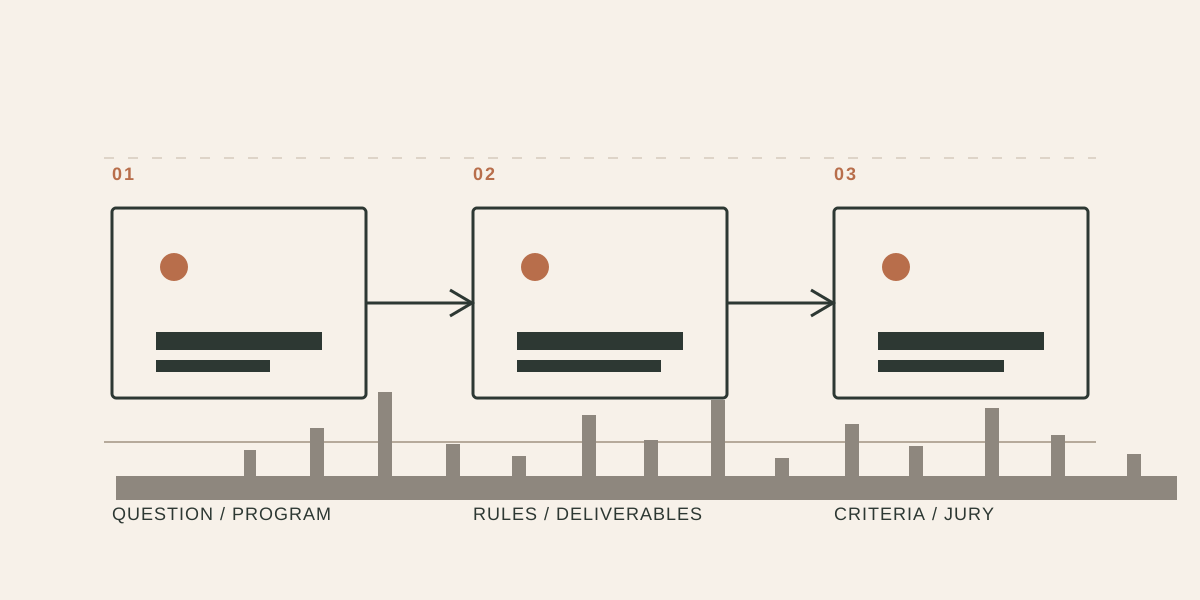
The first step in reading an architecture competition brief is not to give every paragraph the same weight. Separate the document into four layers: the task, binding conditions, deliverables and evaluation. This makes the question being asked, the limits within which it must be answered and the way the proposal will be judged visible on one working sheet. The method below is not a legal interpretation of any particular competition; the current brief and its official addenda always take precedence.
Start with the competition type and its outcome
The International Union of Architects (UIA) describes design competitions in architecture and town planning as formal procedures in which multiple proposals are compared against an announced task, programme and evaluation criteria. Its guide distinguishes ideas competitions from project competitions, as well as one-stage and two-stage processes. That distinction affects not only the form of the submission but also what may be expected from the winner afterwards.
Look for answers to these questions on the first pages of the brief:
- Is the competition asking for an idea or selecting a project that may be delivered?
- Is it open or invited, and is it organised in one stage or two?
- Does the first prize lead to design services or another form of collaboration?
- Does the promoter explain what will happen after the result?
If the answers are scattered, turn the uncertainties into a question list before drawing. The UIA Competition Guide treats the type and outcome of a competition as matters that should be made clear from the beginning. The UNESCO recommendation on international competitions also calls for the purpose, problem and practical requirements to be stated clearly.
Turn the brief into a four-layer reading table
Before reading a long document for a second time, fill in the table below in your own words. If a sentence cannot be placed in a cell, its translation into a design decision may not yet be clear.
| Layer | Question to find in the brief | Record to carry to the drawing board |
|---|---|---|
| Task | What problem is the competition addressing, and for whom? | A one-sentence task; users and context |
| Programme | Which actions, spaces or relationships must be established? | An action and adjacency diagram, not only areas |
| Conditions | Which clauses are mandatory and which leave room for interpretation? | Two markings: “required” and “proposal” |
| Deliverables / evaluation | Which document, at what scale, will be judged by which criteria? | A matrix of drawings, documents and criteria |
The UIA guide recommends distinguishing essential mandatory requirements from conditions that leave the competitor freedom to interpret. This does not suppress an original idea; it places freedom where it can be used responsibly. “Must include” and “may be considered” are not the same sentence.
Read the programme as a relationship diagram
“One hall, two workshops, one foyer” is a list, not yet a design. Add at least four questions to every programme line:
- Who is doing what in this space?
- Does the action happen alone or with others?
- Which thresholds separate public, semi-public and controlled areas?
- Where does a user enter, find direction and decide to stay?
These questions turn phrases such as “accessibility”, “public use” or “flexibility” into spatial tests. Read the programme as a route through time rather than only as an area schedule.
Melike İnal’s Third Place project and its central courtyard and threshold decisions offer a project record for this kind of reading: the shared centre is not leftover space but an instrument that organises circulation and encounter. The field note on Space Syntax opens a related way of thinking about accessibility as a network of connections rather than a linear distance. Test the brief between these two scales.
Separate binding requirements from design freedom
Marking every clause with the same colour can unnecessarily lock a proposal. A simple notation system helps:
- Red: a required submission or technical condition whose absence may make the response non-compliant.
- Amber: a condition about context, budget, phasing or operation that directs the design.
- Green: an area of interpretation in the brief’s aim, atmosphere or relationships.
The colours have no legal meaning; they are a reading discipline. A scale, file format or required document may be red; the way the building supports shared use through the day may be amber; the way thresholds are made may be green if the brief allows interpretation. Derive the actual classification from the competition’s own text.
Make the deliverables an early design tool
The UIA guidance emphasises that the number, nature and scale of plans, sections, models and other documents should be stated clearly in the conditions. Do not leave the deliverables section until the end. Make a small record for each item:
| Document | What does it prove? | Which decision does it support? | Final check |
|---|---|---|---|
| Site plan | Context and access | Placement on the site | North, scale, legend |
| Floor plan | Programme and circulation | User route | Dimensions, labels, line weight |
| Section | Vertical relationships and atmosphere | Light, threshold, height | Levels, human scale, orientation |
| Statement | Reasoning behind the design | From problem to decision | Consistency with the brief |
The aim is not to make every document a separate presentation object. It is to build different pieces of evidence for the same idea. If the plan explains one building and the section implies another, the jury has to perform an avoidable translation. The reading list for architecture students is a complementary archive for thinking about representation across scales.
Make the jury and criteria part of the design
Jury criteria are not headings to discover on result day. Turn phrases such as “urban fit”, “functional quality”, “sustainability” or “deliverability” into visible evidence. Complete this sentence for each criterion:
Which drawing, section, diagram or short paragraph makes this criterion legible in my proposal?
The UIA lists an independent, professional jury, published evaluation criteria and anonymous assessment of entries among its best-practice principles. The RIBA entrant guide likewise recommends that a comprehensive brief explain the stages, criteria, question-and-answer mechanism and, where relevant, a site visit. These are not automatic legal conditions for every national competition; they are strong reference points for checking a brief.
Connect each criterion to a design decision instead of copying it as a heading:
- Context: How does the project relate to neighbours, climate, topography or existing traces?
- Use: Can a user’s route be read in plan and section?
- Public value: What shared space does the project create beyond the property line?
- Deliverability: Which assumptions about material, phasing and maintenance are explicit?
Prepare a one-page competition summary
Compress the brief into one page before the first sketch. This page is for the beginning of the project, not only the final check:
- Task sentence: What problem should the competition address, and in what context?
- Three binding conditions: Which clauses could make the response invalid if ignored?
- Three design questions: What spatial questions does the brief’s freedom open?
- Programme route: How does a user enter, meet, work and leave the project?
- Deliverable matrix: Which question does each board or document prove?
- Uncertainty list: Which answers are missing or contradictory, and how will they be asked through the official Q&A?
This summary is not a shortcut for the brief. It keeps the trail of decisions visible. When your interpretation of a clause changes, add the date and reason to the summary instead of silently changing the drawing. The distance between idea and rule should remain legible.
Final check: originality, rights and scope
Publishing competition drawings or another person’s images without permission is different from analysing a brief with a source link. The UNESCO recommendation and UIA guide both draw attention to the copyright and ownership rights of competitors’ designs. The diagram in this entry was drawn for this archive; it does not copy a competition board or downloaded image.
Before submitting, make these three checks together:
- Does the proposal answer the real question in the brief?
- Does the submission set carry complete evidence of that idea at the requested scale?
- Are sources, uncertainties and design assumptions kept distinct?
Read this way, an architecture competition brief stops being an obstacle opposite creativity. It clarifies the task, makes the boundaries visible and shows where design freedom begins. The final authority, however, is always the current brief, its appendixes and official questions and answers.
Sources
- UIA Competition Guide for Design Competitions in Architecture and Related Fields — International Union of Architects, 2020.
- Revised Recommendation concerning International Competitions in Architecture and Town Planning — UNESCO, 1978.
- RIBA Competitions Entrant Guide — Royal Institute of British Architects.